Designing Smarter Onboarding for Digital Freight Forwarders
Sales blamed lead quality for months. The actual culprit was a single dropdown on the signup form.
Year2025
My roleDesign Lead + Researcher
FocusOnboarding & lead routing
SectorDigital freight forwarding
Seats heldResearch, backlog, rollout
Outcome
What moved.
94%
Leads Correctly Routed
44%
Increase in Registration
40%
Higher Quality Leads
Before the work started
What we believed, what stood in the way, and where the opening was.
Assumption
We assumed users knew which persona they were.
The form asked people to classify themselves as importer, exporter, agent or individual, and the CRM routed on that answer.
They did not know, so they guessed. Every downstream decision inherited the guess.
Challenge
The broken field could not simply be deleted.
Sales, marketing and operations had each built process on top of that persona value, so any change had to keep their systems whole.
Opportunity
Ask what people came to do, not who they are.
Derive the persona from intent and behaviour instead of self-classification, and the routing corrects itself.
Background
iContainers is a pioneer in digital freight forwarding, offering end-to-end logistics solutions. Traditionally a manual industry reliant on phone calls and spreadsheets, iContainers revolutionized the field with instant quotes and online bookings, catering to individuals, moving companies, importers, exporters, and freight forwarders.
The iContainers team, a digital freight forwarder.
Objective
The goal was to streamline iContainers’ onboarding process. User personas (importers, exporters, agents, and individuals relocating) determined critical factors such as pricing, legal terms, sales team assignment, and restrictions on shippable goods, etc. However, the existing registration process used a dropdown field for persona identification, resulting in:
Incorrect user categorization, with majority of users selecting the random options to complete the form quickly.
Misplaced leads between teams, resulting in inefficiencies and poor conversion rates.
My Role: Design Lead & Researcher
I led the redesign of the onboarding process, ensuring alignment between business goals and user needs. Key responsibilities included:
Conducting user research to identify pain points and streamline workflows.
Designing scalable user flows, wireframes, and prototypes.
Establishing a reusable component-based design system for consistency.
Collaborating with developers to ensure accurate implementation.
Validating solutions through usability testing and iterative refinements.
Discovery
Discovery workshop with sales, marketing and operations.
Whiteboarding how each persona was routed through the CRM.
Business Pain Points
Frequent misclassification of leads, especially between B2B and freight forwarders.
Marketing teams manually reassigning unassigned or unattended leads.
Sales teams were overburdened with correcting misclassified leads.
User Pain Points
Confusion caused by irrelevant rates and workflows.
Redundant processes forced users to re-register or repeat information during sales calls.
Observations
60% of users selected the first dropdown option to complete the form quickly.
A/B testing of content and dropdown order failed to eliminate selection bias.
Lack of trust in the system due to poor lead management also impacted other parts of the product.
Key Solutions & Visuals
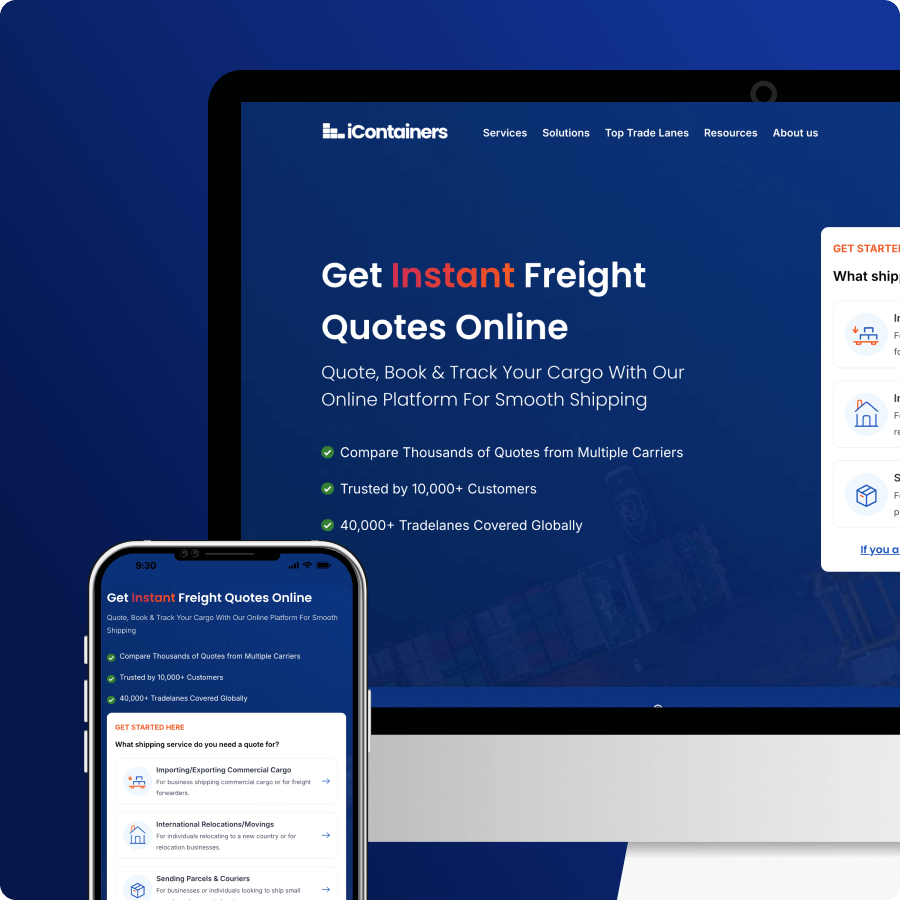
Replaced the dropdown field with an interactive questionnaire to accurately segment users based on their specific needs. Created a conversational and visually engaging onboarding flow, ensuring users felt guided and understood.
Personalized the registration screen with persona-based visuals and tailored USPs, making the process more intuitive and relatable for users.
Persona-based registration screen with its own visual and selling points (1 of 6).
Persona-based registration screen with its own visual and selling points (2 of 6).
Persona-based registration screen with its own visual and selling points (3 of 6).
Persona-based registration screen with its own visual and selling points (4 of 6).
Persona-based registration screen with its own visual and selling points (5 of 6).
Persona-based registration screen with its own visual and selling points (6 of 6).
Results
94%Leads Routed Corrected
44%Increase in Registration
40%Higher Quality Leads
Design Process
Heatmap of the old registration page, showing where attention actually went.
Click map of the registration form, with users rushing past the persona dropdown.
Exit-intent survey asking people why they abandoned registration.
Research: Analyzed CRM data and Hotjar insights to study current lead routing processes and user behavior. Conducted surveys on registration exit intent to identify drop-off reasons.
Definition: Created detailed personas and problem statements to inform and guide the design process.
Ideation: Explored various onboarding concepts, including sales-driven and self-onboarding approaches, to align with both business and customer needs.
Implementation: Led design and owned delivery, collaborating with business and tech teams to deliver the solution. Leveraged the existing design system to streamline implementation.
Testing: Conducted A/B testing with 20% of users in key regions, refining copy multiple times for clarity before the global rollout.
Learnings
With the team in Barcelona.
The iContainers team in the Barcelona office.
Behavior Insights are Critical: Observing user tendencies helped refine the onboarding flow and reduce friction.
Collaboration Enhances Outcomes: Working closely with sales and marketing teams provided actionable insights to improve efficiency.
Iterative Testing Matters: Prototyping and usability testing ensured a polished final design.